How it works
Your body is electric.That much is proven.
The science of the body's electricity, then Jonathan's own seven-level framework, and why he finds the results last.
Nearly every cell in your body holds a small electrical charge, and every movement you choose to make starts as an electrical signal: from the brain, down a nerve, into the muscle fibre, which contracts.
Every contraction is paid for in ATP, the fuel your muscles burn. A sprint runs on quick reserves inside the muscle; over a whole game, most of that fuel is made in the mitochondria, the power stations inside each muscle fibre.
Sport measures this electricity every day: EMG reads your muscles' signals and an ECG reads your heart's. The signal can be trained too: in one study, four weeks of strength training made the nerve signals to the muscle switch on sooner and fire faster.
Jonathan describes his work in the same terms: fresh energy for the charge your body runs on and the signals from nerve to muscle. As he sees it, once that charge is back and built up, muscle, nerve and mind pull together.
He compares it to a laser. Ordinary light spreads out and fades. A laser lines the same light up into one narrow beam that travels far and lands exactly where it is aimed. That, he says, is the difference between his energy and what most practitioners work with: focused, and placed precisely where your body needs it.
“Sports science has mapped the body's current in remarkable detail. It has not studied my work, and I would rather tell you that plainly than claim more. You will judge it as you judge everything else: by how you feel and how you play.”
Jonathan K
The old maps
More than two thousand years ago, Chinese doctors described life in the body as energy, qi, flowing through channels. They named three treasures: the reserve you are born with, the energy that moves you, and the mind. Jonathan sees the old map and the new science as two ways of describing one body, and he recharges all three.
Inside a session
Seven levels,from the outside in.
Before the first session, Jonathan listens: your sport, your goals, your body, and anything weighing on you. He recommends where to begin, and from then on builds each session from what you tell him, knowing intuitively which energies to bring and where to place them. The energy goes where it is needed, even where you cannot name the problem.
The seven levels are Jonathan's own map, built from eighteen years of study and the work since. He goes from the outside in, one level at a time, and at the end he seals the work in. Here is each level as it matters to an athlete, beside what science or tradition says about it.
-
I · The energy around you
Every time a muscle contracts, it gives off faint electrical and magnetic signals, far weaker than the Earth's, yet sensitive instruments pick them up. Energy medicine, from a different tradition, calls the energy in and around us the biofield; Chinese medicine speaks of a protective energy at the body's surface.
In Jonathan's understanding, this is where strain lands first, along with the energy of everyone who wants something from you. He clears out what is not yours, so the rest of the session can reach deeper.
-
II · The channels
Bands of connective tissue run unbroken from your calf, up the hamstring and into your lower back, and part of one muscle's pull carries along them to the next. Chinese medicine maps the body's energy along channels and points.
In Jonathan's experience, knocks, overuse and long seasons leave the channels blocked, and energy cannot reach where the flow is stopped. So before he adds anything, he clears every channel at once.
-
III · Drive and recovery
Your nervous system has two sides you do not control: one revs you up to compete, the other settles you to recover. Chinese medicine describes its own pair: yang for drive, yin for rest and repair.
Jonathan does not balance yin and yang against each other. He raises both, aiming at more drive when you compete and deeper recovery when you rest.
-
IV · Your electricity
A tired muscle keeps firing because tiny pumps keep moving salts in and out of its fibres, and sprint training gives it more of those pumps.
Here Jonathan puts charge back into your body and into the signals that run from nerve to muscle. As he sees it, every signal then gets through at full strength.
-
V · The hormones
Hormones are the body's chemical messengers, and many keep a daily rhythm: cortisol peaks soon after you wake, and melatonin rises in the evening to bring on sleep. That sleep matters to performance: when American university basketball players slept longer, their sprints got quicker and their shooting improved.
Jonathan puts energy into the glands that make your hormones and into the rhythm they keep, aiming for sharper training by day, deeper sleep at night and, for women, a steadier cycle. Nothing is taken or added: he works only with what your body makes itself.
-
VI · The cells
Every tissue is built from cells, and they renew at very different speeds. Muscle rebuilds itself all the time and bone is remodelled slowly, over years, but the core of the Achilles tendon is laid down while you are growing and barely renews afterwards.
Jonathan brings energy into the cells themselves, in muscle, tendon, ligament and bone alike, for vitality right through the tissue. And he gives the tendons that carry a career the attention they hardly ever get.
-
VII · The pattern
Muscle keeps a memory of earlier training: in animal studies, the extra building blocks a muscle fibre gains under hard training stay after it stops, and muscle that has been strong before gets its strength back faster.
This is the deepest level of all, and for Jonathan the heart of it: the pattern of your body at its best, of which muscle memory is one part. In his understanding, the body has not forgotten its best form, and each session is designed to remind it.
Then the seal: one energy holds everything in place, and from there, Jonathan finds, the body carries the work on by itself.
The mind and emotions
Pressure is physical.So is calm.
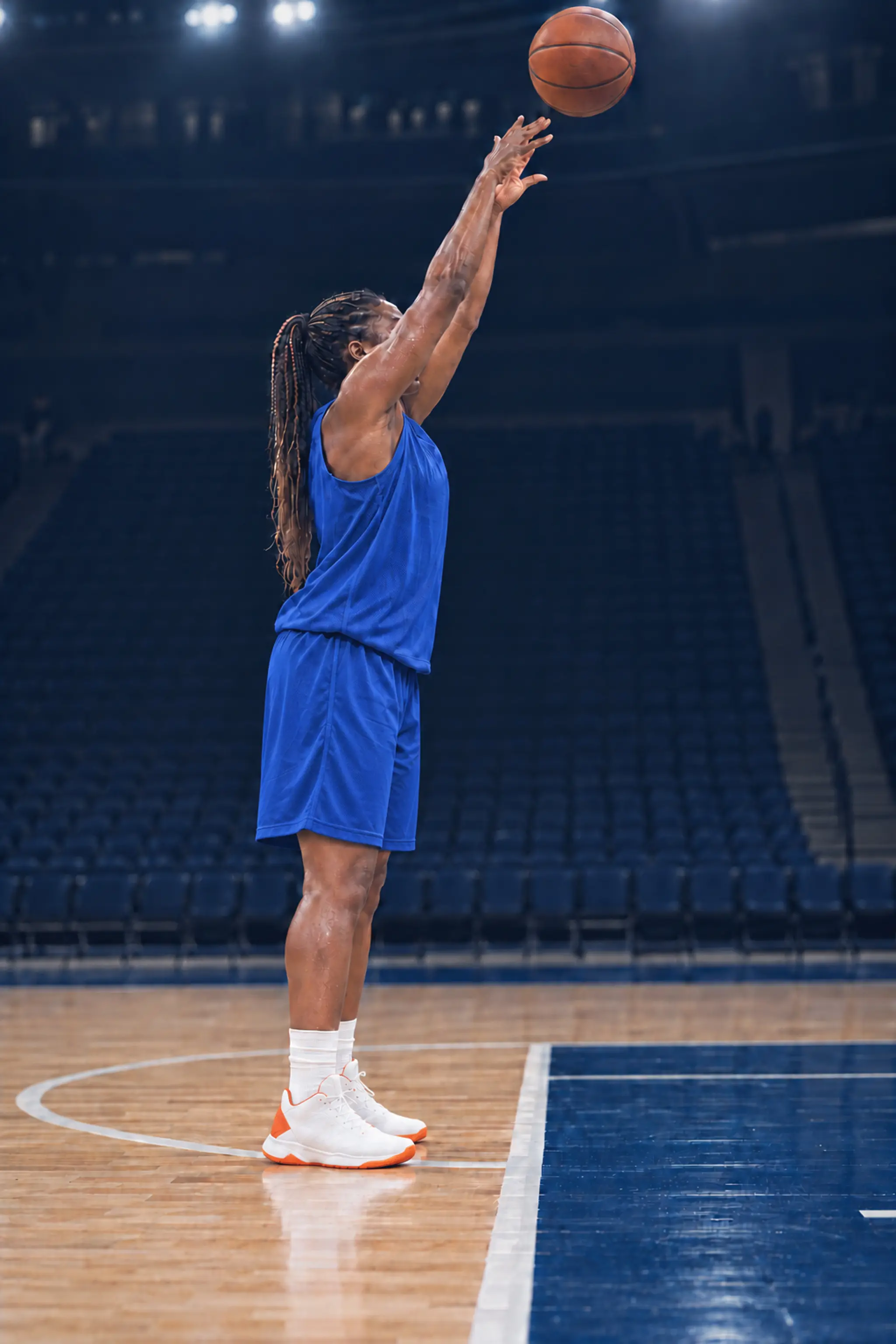
Decades of research show that confidence is a better guide to how an athlete performs than nerves are. Under pressure, focus slips: when basketball players were anxious, the steady last look before each free throw got shorter, their eyes wandered, and more shots missed. And a tired mind can make the same effort feel harder.
Jonathan's weekly sessions work in layers. The first is the pressure of now: the next game or race, the noise, the nerves. Beneath it sit older layers, built up over years, and each session clears a little more and fills the space with fresh energy. That is why the changes keep building for months, and why athletes feel them as confidence that survives a bad start and a head that stays clear as the tiredness builds.
Why the change holds
The body likes to stay where it is; scientists call it homeostasis. For Jonathan, its energy works the same way: lift one or two levels and the others pull them back. So he works through all seven, in order, and seals the work in.
The same at any distance
Jonathan works on the energy around your body, so he never needs to touch you. He explains distance with a picture from physics: two particles that have once been linked, which physicists call entangled, stay linked however far apart they are taken. That is how he understands his own work. In his experience, a session reaches a hotel room on the other side of the world as fully as the next room.
Sources: membrane charge, movement and ATP, hormones and their daily rhythm, and bone remodelling, OpenStax Anatomy and Physiology 2e; lasers, OpenStax University Physics Volume 3; muscle magnetic fields, Garcia and Baffa 2015; motor units, Del Vecchio et al. 2019; fascia, Wilke et al. 2016 and Krause et al. 2016; the sodium-potassium pump, Aughey et al. 2003 and McKenna et al. 1993; sleep, Mah et al. 2011; Achilles tendon, Heinemeier et al. 2013; muscle memory, Bruusgaard et al. 2010; confidence, Woodman and Hardy 2003; pressure and aim, Wilson, Vine and Wood 2009; mental fatigue, Marcora et al. 2009; entanglement, the Nobel Prize in Physics 2022 (Aspect, Clauser and Zeilinger).